What if your phone showed a payment notification at 3 a.m. — and you did nothing to earn it that day? That is not a fantasy for thousands of people using AI tools to build passive income systems. The secret is not working harder. It is building assets that work while you sleep.
AiMoneytool breaks down exactly how to create those assets using AI tools available right now.
What Is AI-Powered Passive Income?
AI-powered passive income is money earned from digital assets you build once — content, products, automated systems — that continue generating revenue without daily effort. The AI handles creation, optimization, and sometimes delivery, while you collect income from the asset over time.
Traditional passive income required large capital (real estate) or years of audience building (blogs). AI collapses both timelines dramatically. A course that once took six months to create now takes three weeks. A blog that once required a team now runs with one person and the right tools.
The key word is “system.” Passive income is not accidental. You build a machine, then the machine runs.
Can an AI-Powered Blog Generate Passive Income?
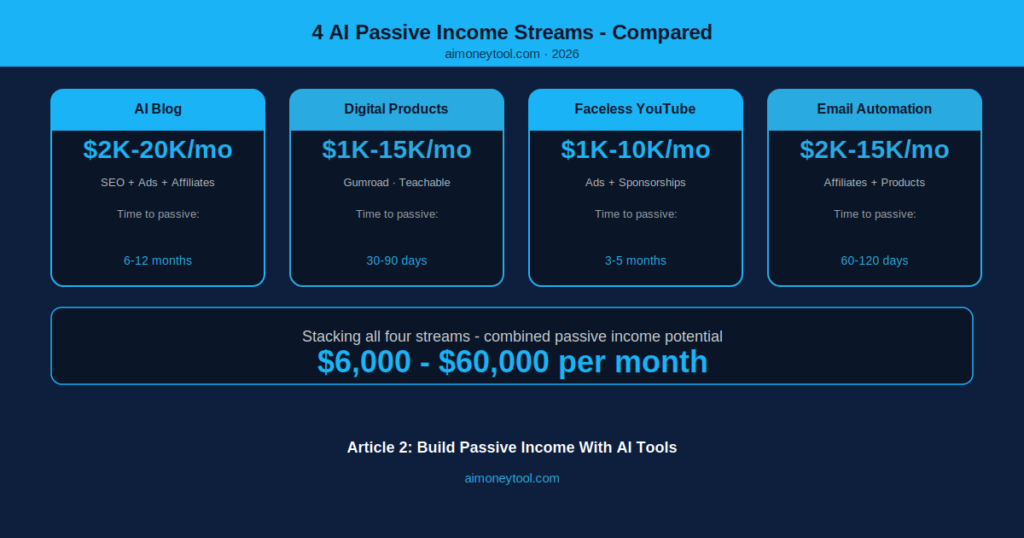
Yes. An AI-assisted blog in a high-value niche can generate $2,000 to $20,000 per month through display ads, affiliate commissions, and digital product sales — with minimal ongoing work once the content library is built. The asset compounds over time as more articles rank and earn.
Tools like ChatGPT, Surfer SEO, and Jasper accelerate content production. A single writer using AI can publish 20 to 40 high-quality articles per month — compared to 4 to 8 without AI assistance.
The income model stacks: ads pay based on traffic volume, affiliates pay based on conversions, and digital products pay regardless of traffic since they sell through email lists.
Finance, health, technology, and AI-related niches consistently show the highest RPMs (revenue per thousand visitors), with top blogs in these categories earning $30 to $80 per thousand pageviews.
How Do AI Digital Products Create Passive Income?
Digital products built with AI — online courses, e-books, template packs, prompt libraries, and software tools — sell 24/7 through automated checkout pages. Once created and listed on platforms like Gumroad, Teachable, or Etsy, they generate income with zero ongoing production cost.
A prompt library for marketers, priced at $29, requires one day to create using ChatGPT and Canva. Sold to 100 buyers per month, that is $2,900 in passive income. Scale to multiple products across multiple niches, and the numbers grow fast.
The best part: AI reduces the quality bar for entry. Products that previously required deep expertise can now be produced by anyone willing to research thoroughly and edit carefully.
Does Faceless YouTube Generate Passive Income?
Faceless YouTube channels powered by AI voiceovers and visuals are one of the most scalable passive income models in 2026. Once a video is published and indexed, it earns ad revenue indefinitely. Channels with 100,000 subscribers in finance or AI niches earn $5,000 to $15,000 per month from ads alone.
ElevenLabs and Murf generate human-quality voiceovers from scripts. Canva and Midjourney produce visuals. CapCut handles editing. A full video can be produced in 90 minutes using this stack.
The passive element kicks in after the first 60 to 90 days when videos begin ranking in YouTube search. Videos published two years ago still earn daily — that is a true asset.
Monetization stacks beyond ads: affiliate links in descriptions, sponsorships, and pinned product sales dramatically increase revenue per subscriber.
What Is the Best AI Automation for Passive Income?
Email marketing automation is the highest-ROI passive income system in 2026. A targeted email list of 5,000 subscribers earning $1 to $3 per subscriber per month generates $5,000 to $15,000 monthly — almost entirely passively once the welcome sequence and broadcast templates are built with AI.
Tools like ConvertKit, Beehiiv, and Mailchimp integrate with AI writing assistants. Your AI drafts the sequences, you refine the voice, and the automation sends them forever.
The list grows passively through SEO content, YouTube, and social media — all of which AI accelerates. Once the funnel is set, new subscribers flow in and revenue scales automatically.
Frequently Asked Questions
How long does it take to build passive income with AI?
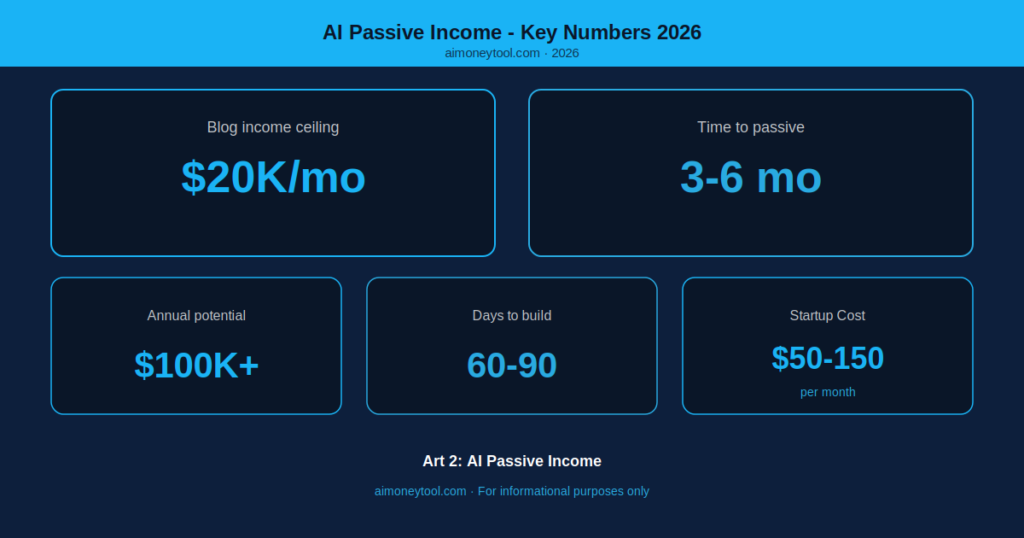
Most AI passive income models take 3 to 6 months to generate meaningful revenue. Blogs need time to rank. YouTube channels need 1,000 subscribers and 4,000 watch hours before monetization. Digital products need an audience or ad traffic to find them. Plan for 90 days of consistent effort before judging results.
How much money do I need to start?
Starting costs are minimal. A blog costs $10 to $15 per month for hosting. AI tools run $20 to $50 per month. A YouTube channel is free. Most passive income systems can be launched for under $100 per month.
Is AI passive income really passive?
The setup phase requires real work — often 2 to 4 hours daily for the first 60 to 90 days. After that, maintenance drops to a few hours per week while income continues. True zero-effort income takes 12 to 24 months to fully mature.
What niche is best for AI passive income?
Finance, personal development, AI tools, health, and business consistently produce the highest passive income per visitor. Pick a niche you can write about credibly, because depth beats breadth every time.
Can I run multiple passive income streams simultaneously?
Yes, and most successful passive earners do. A blog drives traffic to a YouTube channel, which drives email signups, which sells digital products. Each stream feeds the others. Start with one, then stack.
Build Your Passive Income Machine Starting Today
The best time to start building passive income was a year ago. The second-best time is now, because AI has never been more powerful or more accessible.
AiMoneytool gives you the strategies, tool recommendations, and blueprints to build income systems that run without you.
Start with one model from this guide. Build it for 90 days. Then add the next layer.