Every week, thousands of people start trying to earn money with AI tools. Within 90 days, most have quit — not because the opportunity is not real, but because they walked into traps that could have been avoided entirely. This guide names every trap, explains exactly why it kills income before it starts, and tells you what to do instead.
Why Do Most People Fail to Earn With AI Tools?
The majority of people who fail to earn with AI tools make the same handful of mistakes: they choose the wrong starting model, they undervalue their work, they skip the fundamentals of marketing, or they expect passive income to be immediate. None of these failures are due to a lack of AI capability — they are planning and execution errors.
The tools work. The market is real. The people failing are not failing because AI is hard. They are failing because they never had a clear strategy for the part that humans must do: finding clients, building audiences, and delivering consistent value.
Mistake #1: Trying Too Many AI Tools at Once
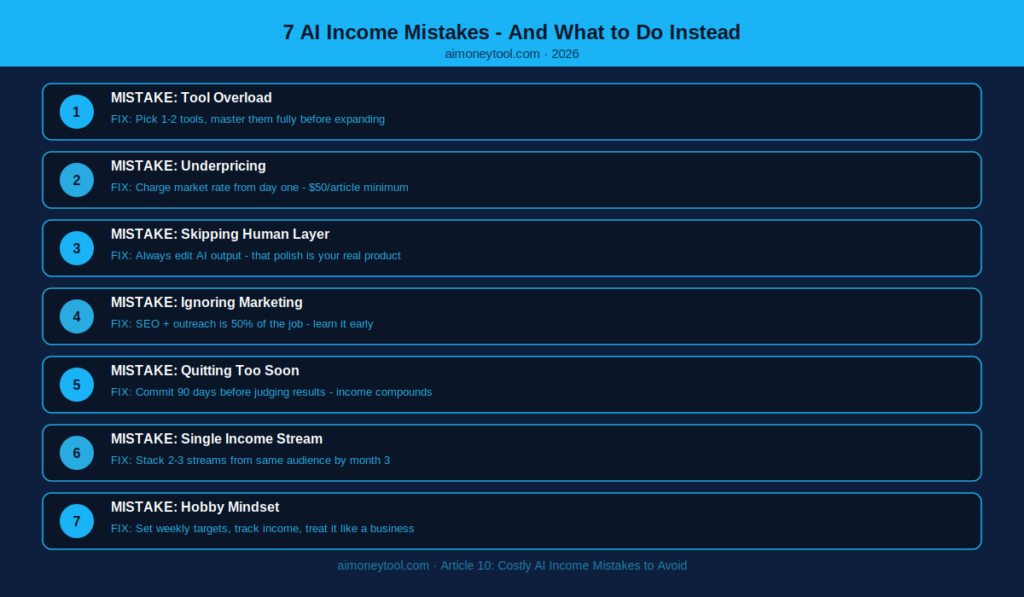
The most common first mistake is tool overload. Beginners sign up for 10 AI tools in week one, spend three weeks learning menus and features, and produce nothing sellable. Income requires output, not knowledge. One tool used well outperforms ten tools used poorly.
The solution: pick one income model first. Then identify the one or two AI tools that serve it best. Master those tools to a sellable standard before adding anything else.
ChatGPT for writing. Canva for design. Zapier for automation. Start with one column, not the entire spreadsheet.
Mistake #2: Underpricing From Desperation
Charging too little is more damaging than charging too much. Underpriced services attract clients who value savings over results — the most difficult, demanding, and least loyal client type. It also signals low confidence to better-paying clients who will never hire you at discount rates.
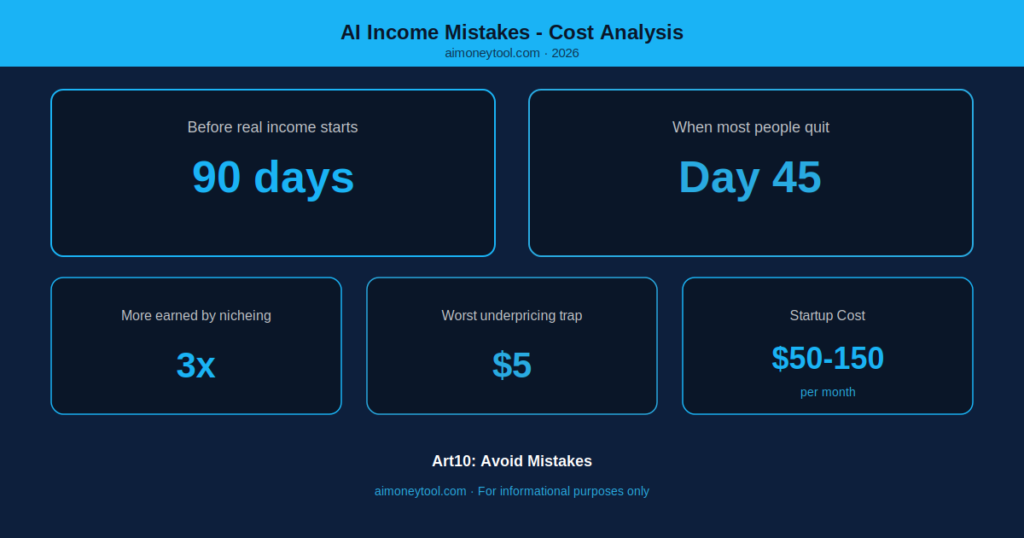
The market rate for AI content writing starts at $50 per article for beginners with a portfolio. Not $5. Not $10. Not “I’ll do it for a testimonial.” Five dollars per article requires 200 articles to earn $1,000 — and it trains you to think small.
Charge what the result is worth. Edit your prices upward quarterly. Loss of one undervaluing client is always a net gain.
Mistake #3: Skipping the Human Layer
AI output without human editing, strategy, and brand voice is immediately detectable — and clients who receive it once rarely return. The income is in the human layer: the judgment, editing, and strategic thinking that transforms AI output into genuinely useful deliverables.
Every piece of AI-generated content should be reviewed for accuracy, tone, originality, and fit. This step takes 15 to 30 minutes per piece and is the difference between a one-time client and a recurring client.
The freelancers earning premium rates are not the ones hiding their AI use. They are the ones adding obvious human value on top of AI efficiency.
Mistake #4: Ignoring SEO and Marketing Fundamentals
Building content, products, or a profile without understanding how buyers find you is the second-most common reason for early failure. Traffic does not happen automatically. Clients do not appear without outreach. Every income model requires a discovery mechanism — and you need to build one before you need income from it.
For content creators: learn basic keyword research before publishing your first article. Target buyer-intent keywords with 500 to 5,000 monthly searches and low competition.
For freelancers: set up a LinkedIn profile optimized for your service, and send five personalized outreach messages per day until the pipeline is full.
Marketing is not optional. It is 50% of the job.
Mistake #5: Giving Up Before the Compounding Kicks In
Most AI income models do not produce significant revenue for 60 to 120 days. Blogs need time to rank. YouTube channels need subscribers. Freelancers need reviews. The people who quit at day 45 never see the income spike that arrives at day 90. Consistency through the slow phase is the only strategy that works.
Set a 90-day commitment before evaluating results. Track leading indicators — articles published, proposals sent, videos uploaded — not lagging indicators like income. Input consistency predicts output eventually. Stopping inputs predicts zero output, always.
Mistake #6: Relying on a Single Income Stream
Single-stream AI income is fragile. A platform changes its algorithm, a client leaves, or a tool shuts down — and income drops to zero overnight. Sustainable AI earners stack two to three income streams from the same audience: a freelance service, a digital product, and a content channel feeding both.
The stacking approach also compounds faster. A freelance writing client who buys your prompt pack and joins your newsletter generates three income streams from one relationship.
Build redundancy into your income architecture from month three onward.
Mistake #7: Not Treating It Like a Business
The final mistake is the most fundamental: treating AI income as a hobby rather than a business. Hobbies are optional. Businesses have systems, goals, client follow-up processes, and financial tracking. The people earning $10,000 per month from AI did not stumble into it. They built toward it deliberately.
Set weekly targets. Track income and expenses. Review results monthly and adjust the strategy quarterly. Treat every client interaction as a business relationship, not a transaction.
One spreadsheet tracking proposals sent, projects won, income earned, and expenses paid separates a growing business from a stalling experiment.
Frequently Asked Questions
What is the single biggest AI income mistake to avoid?
Underpricing. It attracts wrong clients, signals low confidence, and makes scaling nearly impossible. Charge market rate from the beginning, even if it means landing fewer first clients.
How do I avoid producing robotic AI content?
Edit every output aloud. Add one specific personal example or data point per section. Vary sentence length deliberately — mix short punchy sentences with longer explanatory ones. Read the final draft as if you are a first-time reader.
Is it a mistake to use free AI tools when starting out?
No — free tiers are fine for testing and landing first clients. The mistake is staying on free tiers after income starts. Upgrade tools progressively as income grows to maintain output quality.
How do I know if my AI income model is worth continuing?
After 90 days of consistent effort, evaluate: Do you have at least three paying clients or 1,000 monthly visitors? If yes, stay the course. If no, diagnose whether the problem is the model, the execution, or the niche — and adjust one variable at a time.
How do I avoid getting too dependent on one AI platform?
Diversify your tool stack. Use ChatGPT for writing, Claude for editing, Gemini for research. If one tool raises prices or changes policies, your workflow continues uninterrupted.
Avoid the Traps. Build the Income.
The difference between people who earn with AI and people who give up trying is not talent, timing, or luck. It is strategy, consistency, and the willingness to learn from other people’s mistakes instead of your own.
AiMoneytool exists to give you the strategy and shortcut the learning curve — so you hit income milestones faster and waste less time on paths that do not pay.
Bookmark this guide. Come back to it every 30 days. Every mistake on this list is avoidable with awareness.